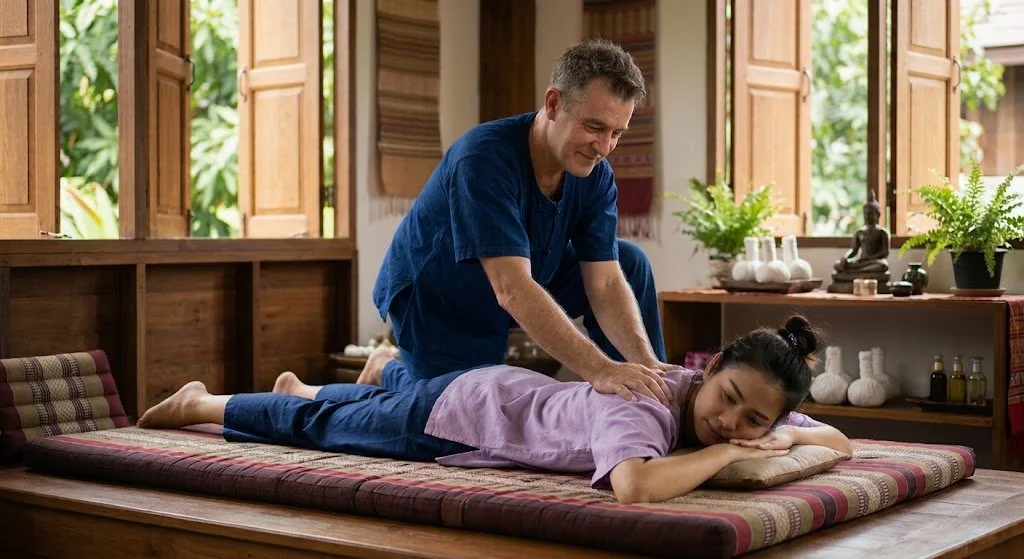
When we look at bodywork through the lens of grounded, soulful healing, true massage isn't a mechanical fix applied from the outside. It is an intimate dialogue with the body's deeper script—a way to help the vital energy (Qi) remember its natural, unhindered flow.
If you want to heal a body, you have to meet it where it actually lives, stripping away clinical coldness and honoring the sacred architecture of human experience. Here is how we translate that philosophy into the core techniques of Tui Na: Traditional Chinese Medicine (TCM) is the basis of the knowledge required to select the correct techniques to use depending on the needs of the client. My acupuncture degree taught me the basics and I have learnt through practice and CPD since my graduation in 2009.
1. Warming and Grounding (Gun Fa & Rou Fa)
Before you can ask a body to release its deepest armoring, you have to invite it into a space of safety. You cannot force a nervous system to open; you have to coax it home.
The Rolling Technique (Gun Fa): Using the soft, fleshy outer edge of the hand and knuckles, we rhythmically roll back and forth across the larger muscle landscapes. It delivers a deep, steady pressure, but it is entirely fluid—rooted in presence, moving with a compassionate rhythm that says, you can let go now.
The Kneading Technique (Rou Fa): Instead of gliding across the surface, we anchor gently. Using a palm heel or thumb, we move in slow, localized circles, drawing the deeper layers of tissue along with us. It is an act of deep listening through touch, helping the fascia untangle its long-held stories.
2. Meeting the Resistance (An Fa & Dian Fa)
This is where we get honest with the blocks, bottlenecks, and places where life got stuck.
The Pressing Technique (An Fa): Direct, perpendicular pressure delivered without rush. We sink in slowly, hold steady when we meet the body's protective walls, and release with absolute care so the system never has to guard itself against us.
Point Pressing (Dian Fa): A more concentrated invocation. Using a single thumb tip or knuckle, we home in on specific acupoints—like gateways on a map. When you press a point like Lao Gong on the palm, you aren't just managing physical pain; you are opening a doorway for the whole system to realign.
3. Clearing the Pathways (Tui Fa & Na Fa)
Once the interior landscape is softened, we help the current move forward.
The Pushing Technique (Tui Fa): Moving in straight, continuous lines along the meridians. If a person is depleted, we push with the flow to nourish them back to life. If they are stagnant, heavy with unexpressed weight, we work with intention to clear the channel.
The Grasping Technique (Na Fa): Lifting, gently pinching, and releasing muscle and tendon groups, particularly around the neck and shoulders where we carry the armor of the world. It is remarkable how quickly this awakens sluggish circulation and sets the energy free.
4. Waking Up the Aliveness (Pai Fa, Ji Fa & Dou Fa)
From time to time the body needs a dynamic reminder of its own vitality—a way to shake off the debris of modern conditioning.
Patting and Striking (Pai Fa & Ji Fa): Using cupped hands to create a light, vibrating cushion of air, or using the side of a fist to deliver gentle, rhythmic percussions. It sounds intense, but it wakes up areas that have gone numb or dormant.
The Shaking Technique (Dou Fa): We take a limb and introduce a continuous, gentle wave of motion through the joints. It is a surrender mechanism—an invitation for the joints to lubricate, the muscles to stop fighting, and the whole being to remember how to flow.
The Heart of the Practice
At the end of the day, authentic healing bodywork isn't about brute force or clinical perfection. It requires us to stay steady (Jiu), keep our rhythm smooth and even (Yun), draw our strength from our authentic center rather than our wrists (Shen), and keep our hands soft enough that the person on the table feels safe enough to drop their armor and come home to themselves. I have practiced Taiji for 25 years and that helps to inform and improve the massage sessions. There is a certain flow that is only attainable by years of practice.