
TRADITIONAL DIAGNOSTICS MEETS PEER-REVIEWED SCIENCE
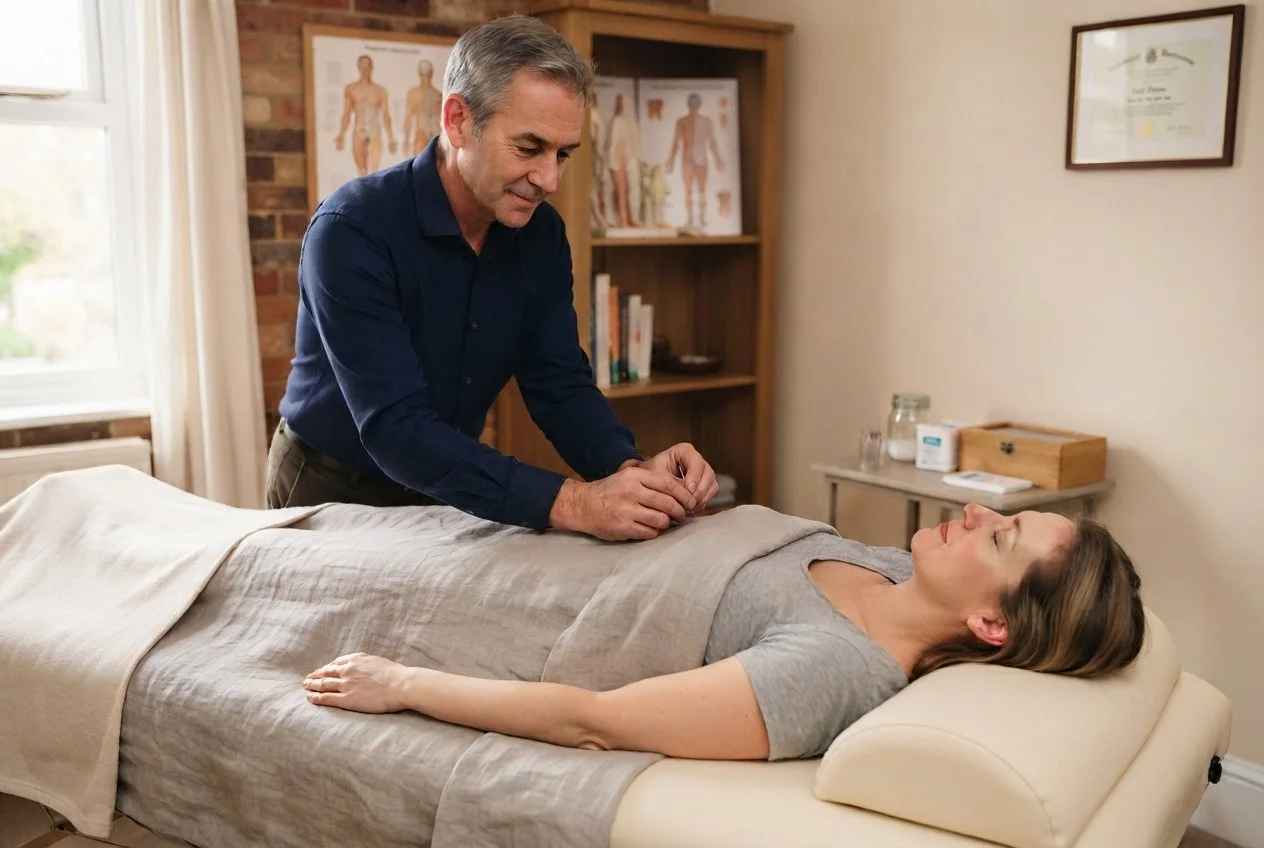
Musculoskeletal pain—whether in the lower back, knee, neck, or shoulder—is one of the main reasons people seek acupuncture. At Geoff Brown Acupuncture (www.geoffbrownacupuncture.com), treating musculoskeletal pain and injury is the core focus across clinics in Hale, Cheshire and Chorlton, Manchester. Graduating with a BSc (Hons) Degree in Acupuncture and a Licentiate in Acupuncture, from the College of Integrated Chinese Medicine (CICM) in 2009, he has combined Traditional Chinese Medicine (TCM) and Five Element acupuncture to offer a well-rounded approach to pain relief. Alongside needling, his practice incorporates Tui Na (Chinese massage), cupping, moxibustion, sports massage, and traditional Thai massage (Nuad Bo-Rarn)—noting that pairing acupuncture with cupping or massage is particularly effective for musculoskeletal conditions.
WHOLE-PERSON ASSESSMENT VS. DRY NEEDLING
A key distinction is the difference between traditional acupuncture and dry needling. Dry needling is sometimes offered by practitioners without full acupuncture training and skips the broader East Asian diagnostic framework. By contrast, a trained acupuncturist evaluates the wider clinical pattern—working to unblock stagnant Qi and Blood along the channels and tailoring point selection and bodywork to the individual. In practice, this supports releasing muscle tightness, increasing circulation, improving joint range of motion, and stimulating the body's natural endorphins.
BIOLOGICAL MECHANISMS: WHAT HAPPENS DURING NEEDLING?
Peer-reviewed neurobiology research helps explain how fine-needle stimulation modulates musculoskeletal pain: - Endogenous Opioid Release: In a review published in Neuroscience Letters, Han (2004) showed that acupuncture and electroacupuncture stimulate the central nervous system to release endogenous opioid peptides—including enkephalins, beta-endorphin, and endomorphin at 2 Hz, and dynorphin at 100 Hz—producing analgesic effects verified across chronic pain conditions including low back pain. - Local Adenosine Signaling: Research in Nature Neuroscience (Goldman et al., 2010) demonstrated that needle stimulation triggers local adenosine release acting on adenosine A1 receptors to reduce pain. A subsequent human microdialysis study in The Journal of Pain (Takano et al., 2012) confirmed that 30 minutes of conventional acupuncture at the Zusanli point significantly increases local interstitial adenosine concentrations during and for 30 minutes after treatment. - Peripheral & Central Pain Pathways: A mechanistic review in the American Journal of Translational Research (Lin, Kotha, & Chen, 2022) further details how ATP and TRPV channels participate locally at the acupoint, while central opioid, serotonin, norepinephrine, and endocannabinoid pathways—together with reduced peripheral COX-2 and prostaglandin E2 via the HPA axis—contribute to pain relief.
CLINICAL EVIDENCE ACROSS MUSCULOSKELETAL CONDITIONS
1. Chronic Musculoskeletal Pain & Long-Term Relief The Acupuncture Trialists' Collaboration (Vickers et al., 2018, The Journal of Pain) pooled raw individual patient data from 20,827 patients across 39 randomised controlled trials covering chronic back pain, neck pain, shoulder pain, osteoarthritis, and headache. Acupuncture outperformed both no-acupuncture controls (~0.5 standard deviations) and sham controls (~0.2 standard deviations; all P < 0.001), with treatment benefits persisting over time—decreasing by only about 15% at 1 year.
2. Knee Osteoarthritis - In a multicentre randomised sham-controlled trial of 480 patients with knee osteoarthritis (442 evaluated for efficacy), Tu et al. (2021, Arthritis & Rheumatology) reported week-8 clinically meaningful pain-and-function response rates of 60.3% for intensive electroacupuncture and 58.6% for intensive manual acupuncture versus 47.3% for sham acupuncture, with both active groups outperforming sham at weeks 16 and 26. - A systematic review and network meta-analysis of 80 trials (9,933 participants) in BMJ Evidence-Based Medicine (Liu et al., 2024) found that acupuncture may reduce knee pain intensity and improve physical function compared with sham, NSAIDs, usual care/wait-list, and no-treatment controls (though overall evidence certainty was very low), identifying electroacupuncture and higher treatment doses as potential contributing factors. - Reflecting its role in multimodal care, the 2019 American College of Rheumatology / Arthritis Foundation Guideline (Kolasinski et al., 2020) conditionally recommends acupuncture for hand, hip, and knee osteoarthritis within shared decision-making.
3. Low Back Pain - A 2020 Cochrane systematic review (Mu et al., Cochrane Database of Systematic Reviews) concluded that for chronic nonspecific low back pain, acupuncture was more effective than no treatment in the immediate term for pain and function, and may improve immediate function and short-term physical quality of life compared with usual care (while immediate post-treatment differences vs. sham were not clinically meaningful; evidence certainty ranged from moderate to very low). - The American College of Physicians (ACP) Clinical Practice Guideline (Qaseem et al., 2017, Annals of Internal Medicine) recommends non-pharmacological therapies—including acupuncture—as initial options for acute, subacute, and chronic low back pain.
4. Neck Disorders In a Cochrane systematic review of 27 trials (Trinh et al., 2016), moderate-quality evidence indicated that acupuncture relieves neck pain better than sham or inactive treatments at completion of treatment and short-term follow-up, and reduces pain and disability at short-term follow-up compared with wait-list controls, with only minor adverse effects.
5. Shoulder Impingement Syndrome A 2024 systematic review and meta-analysis of 5 randomised controlled trials evaluating manual acupuncture for shoulder impingement syndrome (An et al., Medicine) found statistically significant reductions in pain (SMD = -0.50, 95% CI -0.74 to -0.27) and improvements in shoulder function and disability (SMD = -0.57, 95% CI -0.96 to -0.19).
6. UK Guidance for Chronic Primary Pain In the UK, NICE guideline NG193 (2021) recommends considering a single course of acupuncture or dry needling (within a traditional Chinese or Western acupuncture system, delivered in a community setting) for people aged 16 and over managing chronic primary pain.
INTEGRATING ACUPUNCTURE AND BODYWORK IN PRACTICE
While controlled trials typically isolate acupuncture needling on its own, clinical practice often benefits from combining modalities. Pairing acupuncture with Tui Na, cupping, moxibustion, or sports massage—as offered at Geoff Brown Acupuncture—targets both central pain regulation and local myofascial stiffness.
PEER-REVIEWED REFERENCES & CLINICAL GUIDELINES
1. Vickers AJ, Vertosick EA, Lewith G, MacPherson H, Foster NE, Sherman KJ, Irnich D, Witt CM, Linde K; Acupuncture Trialists' Collaboration. Acupuncture for Chronic Pain: Update of an Individual Patient Data Meta-Analysis. The Journal of Pain. 2018;19(5):455-474. doi:10.1016/j.jpain.2017.11.005
2. Tu JF, Yang JW, Shi GX, Yu ZS, Li JL, Lin LL, et al. Efficacy of Intensive Acupuncture Versus Sham Acupuncture in Knee Osteoarthritis: A Randomized Controlled Trial. Arthritis & Rheumatology. 2021;73(3):448-458. doi:10.1002/art.41584
3. Liu CY, Duan YS, Zhou H, Wang Y, Tu JF, Bao XY, et al. Clinical effect and contributing factors of acupuncture for knee osteoarthritis: a systematic review and pairwise and exploratory network meta-analysis. BMJ Evidence-Based Medicine. 2024;29(6):374-384. doi:10.1136/bmjebm-2023-112626 4. Mu J, Furlan AD, Lam WY, Hsu MY, Ning Z, Lao L. Acupuncture for chronic nonspecific low back pain. Cochrane Database of Systematic Reviews. 2020;2020(12):CD013814. doi:10.1002/14651858.CD013814
5. Trinh K, Graham N, Irnich D, Cameron ID, Forget M. Acupuncture for neck disorders. Cochrane Database of Systematic Reviews. 2016;(5):CD004870.pub4. doi:10.1002/14651858.CD004870.pub4
6. An SJ, Shin WC, Joo S, Cho JH, Chung WS, Song MY, Kim H. Effects of acupuncture on shoulder impingement syndrome: A systematic review and meta-analysis. Medicine (Baltimore). 2024;103(37):e39696. doi:10.1097/MD.0000000000039696
7. Han JS. Acupuncture and endorphins. Neuroscience Letters. 2004;361(1-3):258-261. doi:10.1016/j.neulet.2003.12.019
8. Goldman N, Chen M, Fujita T, Xu Q, Peng W, Liu W, et al. Adenosine A1 receptors mediate local anti-nociceptive effects of acupuncture. Nature Neuroscience. 2010;13(7):883-888. doi:10.1038/nn.2562
9. Takano T, Chen X, Luo F, Fujita T, Ren Z, Goldman N, et al. Traditional acupuncture triggers a local increase in adenosine in human subjects. The Journal of Pain. 2012;13(12):1215-1223. doi:10.1016/j.jpain.2012.09.012
10. Lin JG, Kotha P, Chen YH. Understandings of acupuncture application and mechanisms. American Journal of Translational Research. 2022;14(3):1469-1481. PMCID: PMC8991130
11. Qaseem A, Wilt TJ, McLean RM, Forciea MA; Clinical Guidelines Committee of the American College of Physicians. Noninvasive Treatments for Acute, Subacute, and Chronic Low Back Pain: A Clinical Practice Guideline From the American College of Physicians. Annals of Internal Medicine. 2017;166(7):514-530. doi:10.7326/M16-2367
12. Kolasinski SL, Neogi T, Hochberg MC, Oatis C, Guyatt G, Block J, et al. 2019 American College of Rheumatology/Arthritis Foundation Guideline for the Management of Osteoarthritis of the Hand, Hip, and Knee. Arthritis Care & Research. 2020;72(2):149-162. doi:10.1002/acr.24131
13. National Institute for Health and Care Excellence (NICE). Chronic pain (primary and secondary) in over 16s: assessment of all chronic pain and management of chronic primary pain (NICE guideline NG193). Published 7 April 2021.