
Introduction to Thai Massage: The Nuad Bo-Rarn Tradition
Oct 27, 2026 · @Steven Brown
What is Nuad Bo-Rarn?
Nuad Bo-Rarn is the traditional form of Thai massage. Nuad means touch or massage and Bo-Rarn means ancient, so the name translates as "ancient healing touch". It is the original style from which modern Thai massage developed. It combines acupressure along the body's energy lines, assisted yoga-like stretches and gentle rocking. Because the practitioner moves you into the stretches while you relax, it is sometimes called "lazy man's yoga".
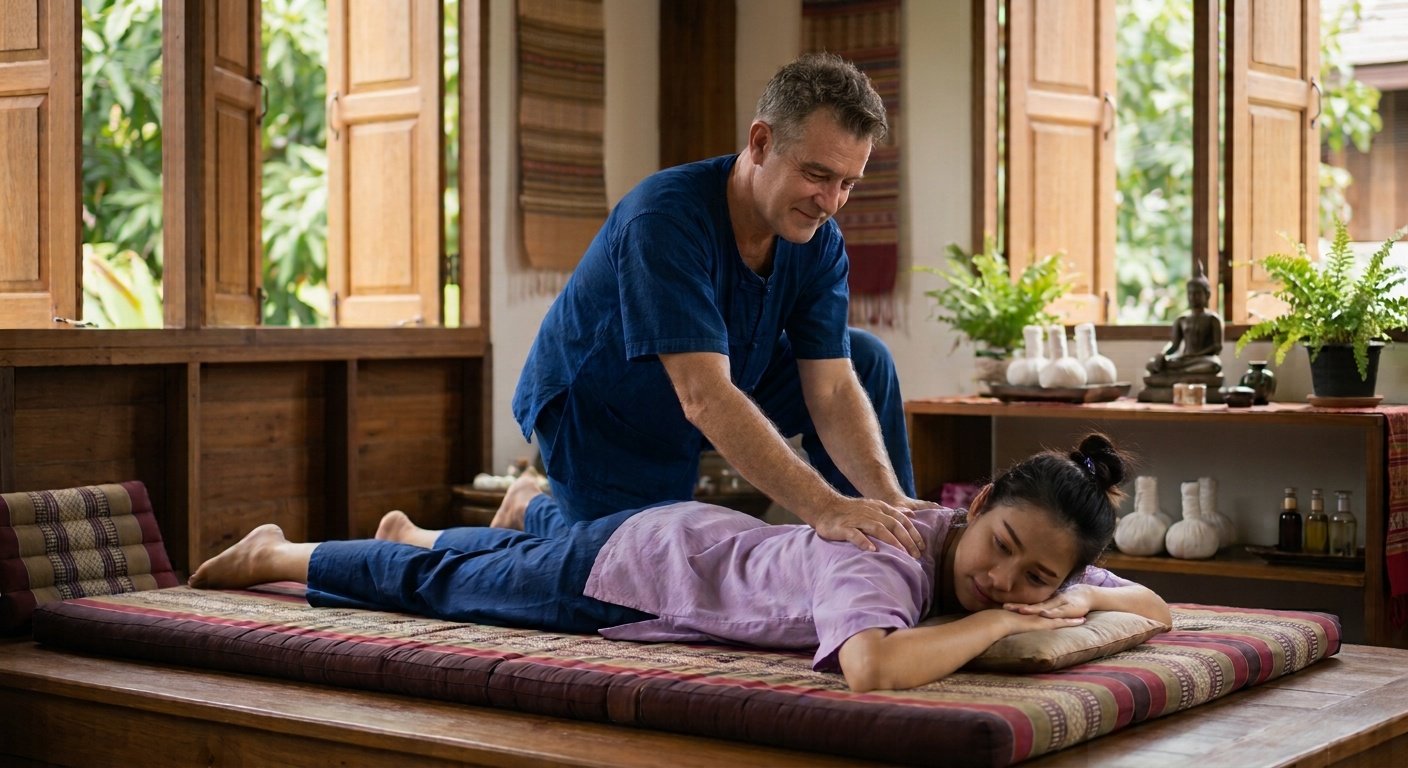
Unlike Swedish or Sports massage, no oil is used. You stay fully clothed and the treatment takes place on a padded mat rather than a couch. The practitioner uses their palms, thumbs, elbows, knees and feet to apply pressure along the body. I practice traditional Nuad Bo-Rarn alongside Chinese and Sports massage at the therapy rooms in Hale and Chorlton.
Origins of Nuad Bo-Rarn
Nuad Bo-Rarn has a history of more than 2,500 years. Tradition credits its founder as Jivaka Kumar Bhaccha, known in Thailand as Shivago Komarpaj. He is said to have been physician to the Buddha and is still honoured as the "Father Doctor" of Thai medicine. The practice spread from India to Thailand with Buddhist monks. For centuries it was taught in the temples, where monks treated the local community.
Nuad Bo-Rarn draws on Indian Ayurveda, Buddhist practice and Chinese Medicine. In 2019 UNESCO added Nuad Thai to its list of the Intangible Cultural Heritage of Humanity.
Northern and Southern Styles
There are two main schools of traditional Thai massage:
Northern style (Chiang Mai) — slower and gentler, with more emphasis on long, flowing stretches. Nuad Bo-Rarn is most closely associated with this style. The Old Medicine Hospital in Chiang Mai is a well known school.
Southern style (Bangkok) — firmer, with more focus on acupressure along the Sen lines. It is taught at Wat Pho, the temple of the Reclining Buddha.
Both styles share the same roots and the same theory of energy lines.
The Spirit of Nuad Bo-Rarn
What makes Nuad Bo-Rarn different from a spa massage is its spiritual foundation. It is practised with Metta, which means loving kindness. This is one of the four Divine States in Buddhism, along with compassion, sympathetic joy and equanimity. The practitioner works in a calm, meditative state, focused fully on the person they are treating.
A traditional session begins with a short moment of stillness, often a prayer of thanks to Shivago Komarpaj. This sets the intention for the treatment. In this way Nuad Bo-Rarn is as much a meditation for the practitioner as a treatment for the client.
The Sen Lines
In Nuad Bo-Rarn, energy flows through the body along pathways called Sen. There are said to be 72,000 Sen, and ten main lines known as the Sen Sib. When these lines become blocked, the result is pain, stiffness and illness. The practitioner works along the Sen with palms and thumbs, and uses stretching to clear the blockages and restore the flow of energy.
This will be familiar to anyone who has had acupuncture. In Chinese Medicine, Qi flows through the meridians. When Qi and Blood are blocked, we feel pain. The Sen lines and the meridians are not identical, but they share the same idea. Many of the pressure points used in Nuad Bo-Rarn lie close to acupuncture points. This is one reason why I find it works so well alongside acupuncture.
What to Expect in a Nuad Bo-Rarn Session
Before the treatment I will ask about your health, any injuries and the areas that are troubling you. Wear loose, comfortable clothing such as tracksuit bottoms and a T-shirt. It is best not to eat a heavy meal for an hour or two beforehand.
The treatment takes place on a padded mat on the floor. This allows me to use my body weight and to move freely around you. A session usually lasts 60 to 90 minutes, though a full traditional treatment can last two hours. It begins with a moment of stillness, then follows a set sequence. It starts at the feet and works slowly up the body to the head. You will be treated in four positions:
Lying on your back
Lying on your side
Lying on your front
Sitting up
The techniques include:
Palm and thumb pressure along the Sen lines
Assisted stretches for the hips, legs, back and shoulders
Gentle rocking to relax the muscles and calm the mind
Joint mobilisation to improve range of motion
The treatment is slow and rhythmical. Breathing is important: I time the stretches with your out-breath so that the muscles release. The pressure can be firm but it should never be painful. Let me know if anything feels too strong and I will adjust it. Most people leave feeling relaxed and lighter, with a greater sense of freedom in their body.
Benefits of Nuad Bo-Rarn
Nuad Bo-Rarn treats the whole person, body, mind and spirit. On a physical level it is useful for a range of musculoskeletal problems. These include:
low back pain
neck and shoulder tension
stiff hips and tight hamstrings
tension headaches
reduced flexibility from sitting at a desk all day
stress and anxiety
The stretches lengthen tight muscles and improve flexibility. The pressure work improves blood flow to the muscles and helps release trigger points. The slow rhythm of the treatment, and the meditative way it is given, calms the nervous system and helps to reduce stress.
What the Research Says
Most studies have looked at traditional Thai massage. Chatchawan et al (2005) compared it with Swedish massage for back pain caused by myofascial trigger points. Both treatments reduced pain, and Thai massage was found to be as effective as Swedish massage. Buttagat et al (2011) found that a single session of Thai massage reduced pain, muscle tension and anxiety in patients with back pain. Damapong et al (2015) studied court-type traditional Thai massage for chronic tension-type headache. They found that it was as effective as the medication amitriptyline in reducing headache intensity.
Further trials are required, but the evidence so far is encouraging. I have found that a combination of Nuad Bo-Rarn and acupuncture is particularly effective for back pain and stiffness.
Answers to some Frequently Asked Questions
Q: Does Thai massage hurt?
A: Thai massage should not be painful. Some stretches may feel strong, especially if you are very stiff, but the pressure is always adjusted to suit you.
Q: How is Nuad Bo-Rarn different from a spa Thai massage?
A: Many spas offer a shortened, oil-based version of Thai massage. Nuad Bo-Rarn follows the traditional full-body sequence on a mat, works along the Sen lines, and is given with Metta and a meditative focus.
Q: Do I need to be flexible?
A: No. The stretches are tailored to your body. Thai massage is a good way to improve flexibility if you feel stiff.
Q: Is Thai massage the same as yoga?
A: Not quite. The positions are similar to yoga, but in Thai massage the practitioner moves you. You stay passive and relaxed throughout.
Q: Who should avoid Thai massage?
A: It may not be suitable if you are pregnant, have recently had surgery, or have a recent injury, a fracture, osteoporosis or a blood clotting disorder. Please tell me about any health conditions before your treatment.
Q: How many sessions will I need?
A: This depends on the person and the condition. Many people feel a difference after one session. For chronic pain or stiffness, a course of three to six treatments usually works best.
Q: Can Thai massage be combined with other treatments?
A: Yes. It works well alongside acupuncture, cupping and other forms of massage.
Book a Nuad Bo-Rarn Session
If you are suffering from back pain, stiffness or stress, Nuad Bo-Rarn could help. It is a natural, holistic way to ease tension and restore balance to the body. Book an online discovery call here or call me on 07935 692 632 to arrange an appointment.
References
Buttagat V, Eungpinichpong W, Chatchawan U, Kharmwan S, 2011, The immediate effects of traditional Thai massage on heart rate variability and stress-related parameters in patients with back pain associated with myofascial trigger points, Journal of Bodywork and Movement Therapies 15(1): 15–23
Chatchawan U, Thinkhamrop B, Kharmwan S, Knowles J, Eungpinichpong W, 2005, Effectiveness of traditional Thai massage versus Swedish massage among patients with back pain associated with myofascial trigger points, Journal of Bodywork and Movement Therapies 9(4): 298–309
Damapong P, Kanchanakhan N, Eungpinichpong W, Putthapitak P, Damapong P, 2015, A randomized controlled trial on the effectiveness of court-type traditional Thai massage versus amitriptyline in patients with chronic tension-type headache, Evidence-Based Complementary and Alternative Medicine 2015: 930175
UNESCO, 2019, Nuad Thai, traditional Thai massage, Representative List of the Intangible Cultural Heritage of Humanity